|
The
Loss of Halifax LL358 MA-Y
8/9 August 1944 : Operation Tom 53
|
| Crew
of Halifax LL358 MA-Y
The
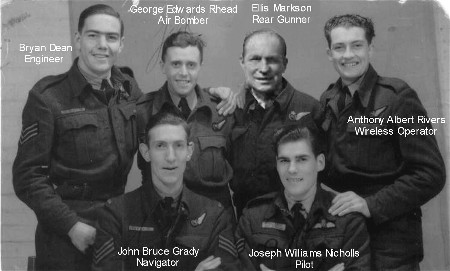
aircraft carried a crew of seven:
Pilot - F/Sgt. J W Nicholls (22)
Navigator - W/Op. J B Grady (RCAF) (26)
Air Bomber - P/O G E Rhead (28)
Wireless Operator - Sgt. A A Rivers (23)
Engineer - Sgt. B C F Dean (27)
Dispatcher - Sgt. C G Bragg (20)
Rear Gunner - Sgt. E Markson (38)
|
| |
Except
for the dispatcher on this mission this crew had flown eight missions
of this type together, and would have been quite skilled. The previous
mission on the 5/6th August dropped 2 agents with 3 containers and 3 packages
into the area around Chouzy in the Touraine.
|
| The
Mission
This was a dual mission being flown with another Halifax piloted by F/Lt.
Abecassis, the mission was to supply an underground cell in the Picardie
area that was being run by Capt. Etienne Dromas. This group of the French
underground had successfully helped over eighty downed Allied airmen to
escape capture and even to return to England through its network. This
drop of arms and explosives was packed into special canisters and packets
designed to withstand impact with the ground but which could still be
taken apart and carried by one person.
|
| The
Flight
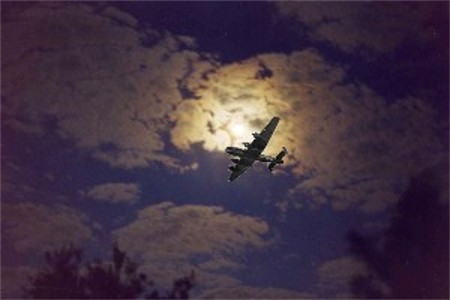
On the night of 8/9 August 1944, two specially adapted Halifaxes of 161
Squadron left Tempsford on a mission for the SOE (Special Operations Executive).
F/Lt. Abecassis took off in Halifax MA-Z LL453 at 23:45 and F/S Nicholls
in MA-Y LL358 followed 10 minutes later at 23:55; the duration of the
flight was expected to last a little over 4 hours. Pinpoint navigation
was required to find small villages, and then dead reckoning was used
to set a course to the target area. Once found, the aircraft flew in at
a little over stall speed (in this case 145 mph, at 400 to 500 feet).
Time spent over the target ranged from 10 to 15 minutes. The ETA was 01:52
and 01:58. However, reception was finally found with a Morse flashing
at 02:09 by F/LT Abecassis, and 15 containers and 7 packages were dropped
on the first run.
His debriefing notes state – "When making drop, an aircraft
was seen ablaze about 3 miles to the south east."
|
| From
the ground at the drop site.
The
French reception committee, commanded by Capt. Dromas, was at the drop
zone before the required time and had heard a German night fighter flying
up and down the area. However, it seemed that he had left when the two
Halifaxes arrived. So it was decided to flash the Morse signal to bring
the aircraft in. F/Lt. Abecassis flew in low, dropped his load and climbed
away to allow the second Halifax to come in; the signal was flashed, and
Nicholls responded. As he came in there was a burst of gunfire from the
German night fighter; the aircraft was hit and on fire; it banked, and
crashed into the field, bursting into flames. All 7 members of the crew
were killed.
The French ran to the aircraft but could do nothing; the crew had been
incinerated in their seats. As they had been flying so low, there had
been no time for anyone to bail out.
|
| |
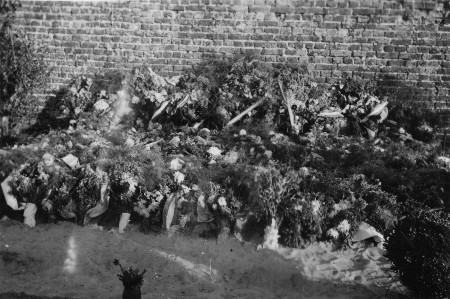
The
next day at the Village of Cugny.
The next day the bodies were removed, placed in numbered coffins, and
taken to the Cugny cemetery. The Germans, fearing an emotional outburst
of anti - German feeling, forbade the townspeople to attend the burial.
In defiance, the entire village (at great risk to themselves), turned
out en masse to shower the caskets with flowers, while members of the
Gestapo looked on.
|
|
Back
at Tempsford.
The aircraft was posted missing, and F/Lt. Abecassis was debriefed. However,
the Squadron Commander, W/Cdr. Alan Boxer was not satisfied and requested
SOE to try to find out what had happened to their aircraft on "Tom
53". A radio message was dispatched to the French requesting information.
A copy of the reply was forwarded to the Station Commander that the aircraft
had indeed been shot down and all the crew killed. To the families of
the dead airman the usual telegrams were dispatched stating they were
missing in action and, after a while, the Red Cross returned some personal
items found on the bodies.
|
After
the war.
After the war the crew were left where they lay in the small cemetery
at Cugny, probably at the request of the French. In 1971 the Mayor of
Cugny asked permission from the Queen to place a memorial by the roadside
where the aircraft had crashed. This was granted, and a stone inscribed
with the names of the crew still stands there today.
|
|
Capt.
Étienne Dromas survived the war as a hero and set up a museum as
a memorial to the French underground in the Picardie area. It is called
the Musée de Résistance et Déportation de Picardie,
and has an exhibit about the events of the 8/9 August 1944. |
Postscript
On
the night of 8/9 August 1944 it seems that Ofw. Todt of I/jg301 flying
a ME109g-6 claimed a Halifax destroyed in some unspecified area near the
south of Belgium / northern part of France, probably compatible with Cugny.
He is credited with downing 11 allied aircraft.
|
Researched
by Dennis Markson
Additional research Bob Body (GR)
Stephane Muret (FR) |
|
Sunday, March 12, 2023 16:02
|